Good evening, all French Bulldog owners. I am your long‑time friend, a practitioner with more than ten‑year experience in pet medicine and behavioural correction. When night lights come on and I see you strolling through bustling night markets with your beloved French Bulldogs, I understand the joy of sharing such lively moments — yet I also hold my breath with concern. I have treated countless pets rushed into emergency care in the middle of the night after accidental ingestion, suffering severe vomiting, diarrhoea and agony, while their owners were overwhelmed with regret. Today we will discuss this hidden danger of night‑market walks: food scraps on the ground, and how to build solid safety defences for your French Bulldog.

Why Do French Bulldogs Act Like “Vacuum Cleaners” at Night Markets?
First, scavenging behaviour is not caused by naughtiness or defiance. It originates deep within their instincts and physical traits.
1. Powerful sense‑of‑smell drive: Despite their flat faces, French Bulldogs possess far more olfactory cells than humans. Grease from grilled skewers, spilled bubble‑tea residues and fried‑food crumbs that barely register to us smell like rich, tempting feasts to a French Bulldog’s nose. This instinct is extremely hard to resist.
2. Historical heritage as working dogs: Bulldog ancestors were bred to control bulls, requiring immense courage and focus to complete their tasks. This trait of intense concentration and rapid reaction toward targets survives in modern French Bulldogs, showing itself as quick snapping and swallowing toward moving objects or “prey” such as rolling scraps of food.
3. Exploring the world through their mouths: Dogs, especially puppies and curious adults, explore their surroundings orally. Licking, chewing and swallowing are how they make sense of new things.
4. Underlying nutritional or behavioural issues: Frequent scavenging may occasionally signal unbalanced daily nutrition, or boredom and anxiety that the dog tries to relieve via foraging behaviour.
Field‑Proven Solutions: How I Helped Food‑Obsessed French Bulldogs Break Bad Habits
One French Bulldog named Potato left a deep impression on me. His owner dared hardly take him anywhere with food waste, because he could spot and swallow scraps off the ground in the blink of an eye, too fast for his human to react. Shouting and yanking the leash achieved very little; instead Potato grew more alert toward ground items and swallowed even faster. For Potato and similar cases, I developed a combined strategy with remarkable results.
Solution 1: Environmental Management — Build Physical Barriers
Before behavioural habits change, managing the environment is your first and most immediately effective step.
• Wear a suitable muzzle: This is the most direct physical safeguard. Choose a basket‑style muzzle that permits drinking, panting and tongue‑based heat dissipation but prevents large‑mouth biting and swallowing. Highly recommended for high‑risk settings such as night markets. Complete desensitisation training at home beforehand: associate the muzzle with treats and pleasant walks so your dog accepts it without resistance. For Potato I chose a lightweight breathable basket muzzle. At first he disliked it, but short daily wear before meals paired with high‑value rewards helped him adapt within one week.
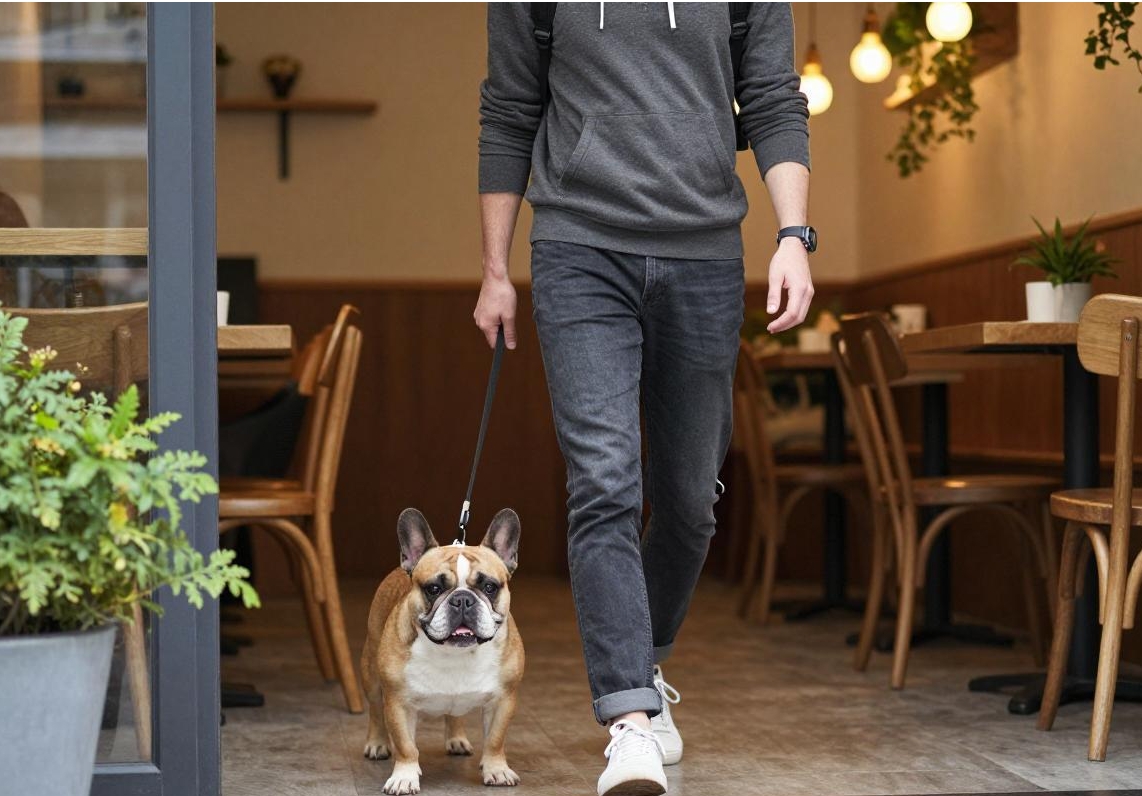
• Upgrade walking gear: Use a fixed‑length short leash (around 1.2 m) rather than retractable leashes. Short leashes give you better control over your dog’s proximity to the ground and its range of movement. Combine a harness with a double‑ended leash: one clip attaches to the back for general guidance; the second clip fastens to the chest ring. When your dog tries to lower its head, gently lift via the chest attachment. This softly and effectively stops scavenging attempts, far gentler than sharp pulls on neck or back, and safer for brachycephalic breeds such as French Bulldogs.
• Choose cleaner routes: Avoid high‑scrap zones such as barbecue stalls, snack‑shop entrances and rubbish bins. Prefer inner sidewalks or relatively clean pathways.
Solution 2: Behaviour Training — Build Mental Firewalls
This addresses root causes and demands patience and consistency from owners.
• Reinforce the “Look at me” cue: This is the foundation of all training. In quiet surroundings, teach your dog to lift its head and make eye contact immediately after hearing its name or the cue, rewarding every correct response. Gradually add distractions and finally practise in night‑market‑like environments. When Potato attempted to sniff the ground, his owner would say clearly and cheerfully: “Potato, look at me!”. Every time he lifted his gaze, he received a tiny piece of his favourite chicken jerky. He learned that paying attention to his owner yielded better rewards than hunting garbage.
• Practise “Drop it” and “Leave it” cues: Start indoors using toys for “Drop it”, trading the toy for higher‑value food. Progress to placing low‑value treats (kibble) on the floor. When your dog moves toward them, gently cover the food with your foot and say “Leave it”. As soon as it abandons interest and looks toward you, instantly reward with something premium such as cheese. This builds the understanding: items on the ground are poor, while rewards from the owner are precious. After mastering these cues, even if Potato snatched something quickly, he would release it upon hearing “Drop it”, buying precious time for emergency response.
• Increase walk‑time engagement: Intersperse short training drills such as heel and sit with rewards, or bring favourite squeaky toys. Keep your dog focused on you and interactive games instead of sniffing the ground.
Solution 3: Daily Care and Health Adjustments
• Guarantee complete nutrition: Consult your vet to confirm your dog receives well‑balanced daily meals. Pica‑like scavenging can occasionally stem from trace‑element deficiencies.
• Satisfy mental enrichment needs: Provide sufficient mental stimulation and physical exercise each day: sniffing mats, treat‑dispensing puzzle toys and brain games burn surplus energy and reduce boredom‑driven scavenging urges.
• Support intestinal health: For French Bulldogs with sensitive digestion, feed vet‑approved pet probiotics routinely to support gut flora, offering partial buffer should accidental ingestion occur.
Pitfall‑Avoidance Guide: Common Mistakes You Might Be Making
1. Violent leash‑yanking and loud scolding: This increases stress and over‑excitement. Your dog may interpret your actions as competition over “prey” and swallow faster. It can injure a French Bulldog’s trachea and erode mutual trust.
2. Reaching fingers inside the dog’s mouth: Extremely dangerous! You risk being bitten instinctively, or pushing food deeper down the throat and causing choking.
3. Taking reckless chances: Thoughts such as “Just once will not hurt” or “I am watching so it cannot eat anything”. Dogs swallow with lightning speed. Danger often strikes the very moment you glance at your phone.
4. Abandoning training halfway: Behaviour modification requires consistency. Do not alternate strict days with lax days. Until habits are firmly established, physical protection such as the muzzle must remain in use.
Summary
Keeping French Bulldogs safe in night‑market environments combines human vigilance and technical safeguards. Human‑led protection means owner alertness, proper gear (muzzle, short leash) and thoughtful route planning. Training‑based protection relies on consistent positive reinforcement of cues like “Look at me” and “Leave it”, redirecting your dog’s focus away from ground litter toward you. Our goal is not to suppress exploratory instincts, but to teach dogs how to live safely and happily within complex human surroundings.
Important Reminder
Even with thorough preparation, accidents can still happen. If you observe any abnormal signs after suspected ingestion including vomiting, diarrhoea, excessive salivation, lethargy, abdominal pain (prayer‑like posture), breathing difficulty or convulsions, do not wait and observe. Contact your veterinarian immediately or drive straight to the nearest animal hospital.